Tuesday, May 25, 2010

Solve Anything with Dr. Mark: Career Advice for the Working Class

Dr. Mark's Interview with J.P. Hansen
As seen in the L.A. Times

Any questions?
Q: I was rejected for a job I recently interviewed for. I thought the interview went well until the end. The interviewer checked his watch, and then asked, “Do you have any questions?” I thought I would gain bonus points by answering, “No, you’ve covered everything.” My recruiter said this left a bad taste in the interviewer’s mouth. Under the circumstance, I wonder now if I should have asked a question.

A: In my capacity as a career advice columnist, I occasionally come across an expert resource that makes my job of providing my readers with information easy. One such person is J.P. Hansen, executive recruiter and author of The Bliss List: The Ultimate Guide to Living the Dream at Work and Beyond! (Career Bliss Publications, $19.95). Regardless of perceived time constraints (like checking a watch), a well thought-out question at the end of the interview is often the clincher. It is customary to ask a question or two at the end, but probably not more than two. I asked Hansen about what to say when asked, “Do you have any questions?”
• Always have questions. Prepare at least five good questions that demonstrate your research on the company. It’s customary to blank out when asked this question at the end of an interview so bring a notepad.

• “No, I think you’ve covered everything” underwhelms the interviewer and will likely get you the boot rather than the offer.

• Ask the “kiss-up” question, the one that highlights a positive about the job or company: “With the impressive results the company has had in the past, where do you see the company in the next five years?” or “Customer XYZ said great things about your company and your high-quality service levels. How do other customers view you?”

• Before leaving, always ask for the job. A successful closing often cements a job offer: “Do you have any concerns about my ability to do this job or any subsequent jobs with this company in the future?” If yes, find out why and sell yourself one final time. If no, say, “When can I start?”

• Some interviewers ask you to interview them. Be prepared.

Develop a killer resume
Q: I hate writing my resume. I have a hard time not sounding too egotistical or cliché. Is the resume really that important or isn’t it more important to interview well?

A: Most people have a difficult time writing a resume, let alone one that reaches the top of the pile. Though the job market is rebounding, jobs are still somewhat scarce and competition is daunting. Your resume is a critical stepping stone to obtaining an interview. Failure to impress the hiring manager can send your candidacy into the round file.

Hansen’s advice:

• Your resume is your invisible first impression and it goes without saying how important first impressions are.

• Be clear and concise.

• Avoid the one-page myth. Length doesn’t matter (in resumes). Don’t undersell your background by trying to shoe-horn your experiences onto one page.

• The best resume covers two areas: (1) activities and (2) accomplishments in chronological order. Use sentences in paragraph form for the activities and bullet points to highlight your accomplishments.

• You don’t need to spend more than $100 on a resume service. It’s best to write your own so it’s easy to tailor it to match your dream job.

• Accomplishments win you an interview. Spend time on your accomplishments and quantify and qualify them.

• Avoid “Objectives” and “Career Summary.” They are redundant and do not belong on a resume.

• Some resume don’ts: no pictures of yourself (I’ve seen ’em) and no flowery verbiage. If it can be stated with fewer words or syllables, do it. Nocolored paper or cheap copier paper — use cottonbond white paper.

• Spell check and read every word. Have another set of eyes proof read with a fine tooth comb. I wrote “manger” on one of my resumes by mistake. Though manger is a word and passed spell-check, I wasn’t applying for a nativity scene and “manager” worked better. Though a hiring manager spends less than 30 seconds on average on your resume, don’t let a typo negate your strong background.

Thursday, May 20, 2010

The Bliss List Wins in The Next Generation Indie Book Awards!


Congratulations!
Author J.P. Hansen was recently named the winner of the Next Generation Indie Book Awards in the Career category for his book, The Bliss List: The Ultimate Guide to Living the Dream at Work and Beyond! The results will be officially posted at www.indiebookawards.com/ in the next several weeks.

To find out more about J.P. Hansen, visit his website at http://www.yourblisslist.com/. The book is available at your favorite bookseller or online at the following retailers:


Thursday, April 22, 2010

John Hlavacek to be Inducted into Journalist's Excellence Hall of Fame

Saturday evening, John Hlavacek will be inducted into the Omaha Press Club's Journalists of Excellence Hall of Fame. John served as a foreign correspondent in China during World War II and later as bureau chief in India from 1944-1952. Following this, from 1958-1963 he was the NBC bureau chief in Havana and Miami before moving to KMTV in Omaha in 1964.
John is also the author of several books, detailing his time in each of these positions around the world. They inlcude Letters Home: An American in China: 1939-1944, United Press Invades India: Memoirs of a Foreign Correspondent, 1944-1952, and Freelancing in Paradise: The Story of Two American Reporters Who Supported Their Family by Covering Turbulent Times in the Caribbean, 1958-1963, which he co-authored with his wife Pegge Parker Hlavacek.

John's wife, Pegge, was also a foreign war correspondent in places such as China, India, and Pakistan, and reported with John from the Carribbean. She is the author of several books, (which John editied) including 'Teen Topics by Pegge Parker, Alias Pegge Parker, Diapers on a Dateline, Slow Boat to China, and Slow Boat to Pakistan. The books chronicle their lives in exquisite detail, as they documented their journeys writing letters, articles, journals and preserving momentos and artifacts throughout their lives.

Dave Hamer, Deanna Sands and Dottie Hayes Sater will also be inducted into the Journalist's Excellence Hall of Fame Saturday evening. For the official press release visit http://www.omaha.com/article/20100421/NEWS02/704219889. For more information about John and Pegge Hlavacek, visit http://www.hluckybooks.com/.

Thursday, April 15, 2010

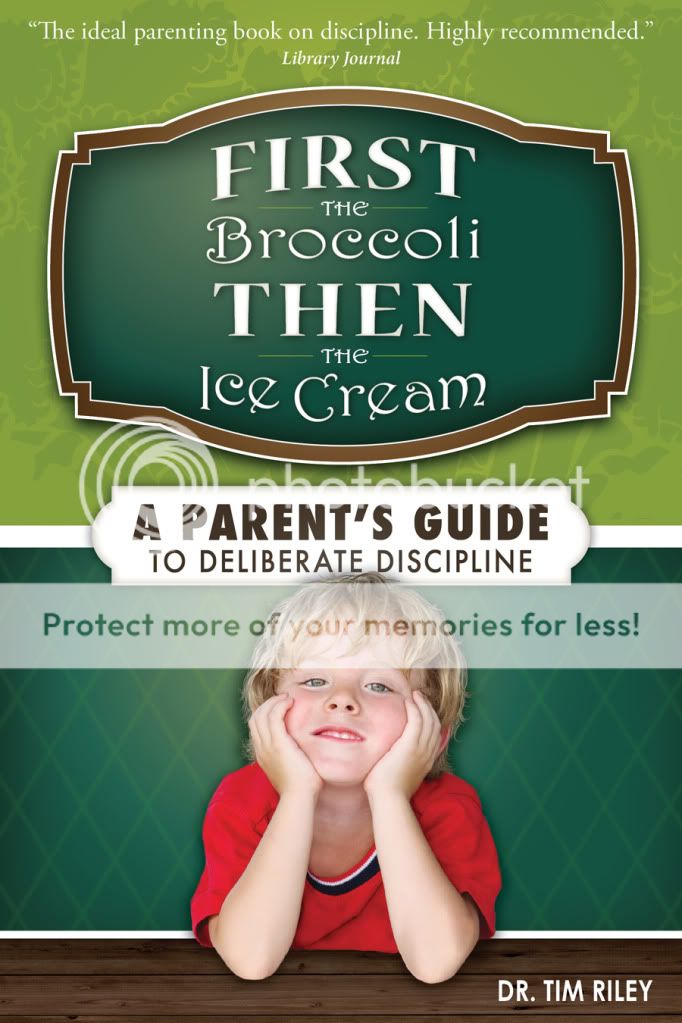
First the Broccoli, Then the Ice Cream is Now Available!!

Today is the offical launch of Dr. Tim Riley's new book, First the Broccoli, Then the Ice Cream: A Parent's Guide to Deliberate Discipline.

Library Journal gave it a Starred Review, and said the following:
"Psychologist Riley has written an ideal parenting book on discipline. In fact, his advice transcends his own subject and could easily serve as an entire parenting philosophy. Riley's style is warm and engaging, and he clearly cares for children and their well-being. Riley's solid contribution is highly recommended."
ForeWord Clarion Review gave it a Five Star Review, and said:
"The strategies offered in the book are simple to follow and include tips on how to modify the strategy if it isn't working for your child. Parents, caregivers, and teachers will benefit from the behavioral strategies offered here."

Gail Reichlin, Executive Director of The Parents Resource Network and co-author of The Pocket Parent said:
"With clarity, wit, and wisdom, Dr. Tim Riley offers a key understanding of why children do what they do as he skillfully guides moms and dads in developing their own structured approach to effective discipline. Parents will appreciate the friendly tone, real life examples, and sensible, specific strategies for a variety of common challenging behaviors."
Susan M. Wilczynski, Ph.D., BCBS said:
"If you think reading this book will magically lead to the perfect child, you will be disappointed. But get this book if you're interested in learning how to raise your child or adolescent in our complex world. You will find clear, common sense recommendations supplied alongside real world examples."
To learn more, visit http://www.firstthebroccoli.com/.
The book is available at your favorite bookseller or online at the following retailers:


Thursday, February 25, 2010

Watch for these upcoming titles!

Watch for these upcoming titles!


First the Broccoli, Then the Ice Cream: A Parent's Guide to Deliberate Discipline

Dr. Tim Riley
Two Fish Books
Release Date: April 15, 2010

Essentially a how-to manual for parents."
5 of 5 Stars, ForeWord Clarion Review

"(*Starred Review) ...Riley's advice transcends his own subject and could easily serve as an entire parenting philosophy. Emphasizing that rules without consequences are just suggestions and reminding us that anything over seven-words is a lecture, he has an understated and humorous approach that is personal and effective. Riley's style is warm and engaging, and he clearly cares for children and their well-being. HIGHLY RECOMMENDED!" -- Library Journal, March 2010


Slow Boat to China: The Personal Diaries and Letters of Pegge Parker, 1942-1951

Pegge Parker
Hlucky Books
Release Date: April 1, 2010


Slow Boat to Pakistan: The Personal Diaries and Letters of Pegge Parker, 1951-1952

Pegge Parker
Hlucky Books
Release Date: April 1, 2010


Mail-Order Kid: An Orphan Train Rider's Story

Marilyn June Coffey
Out West Press
Release Date: April 1, 2010


Delicious! The Savvy Woman's Guide to Living a Sweet, Sassy and Satisfied Life

Catrice M. Jackson
Catriceology Enterprises
Release Date: April 1, 2010


Fireside Chats, A Surrealist's View of the World

Frank O'Neal
Love's Jazz & Arts Center
Release Date: April 1, 2010


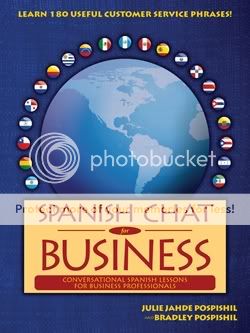
Spanish Chat for Business

Julie Jahde Pospishil & Bradley Pospishil
Spanish Chat Publishing
Available Spring 2010


Congratulations to our friend Myles Garcia on the Amazon CreateSpace release of his new book, Secrets of the Olympic Ceremonies.

Myles A. Garcia
Myles A. Garcia Publishing
Available on Amazon

Thursday, October 1, 2009

The publishing world is your oyster -- and your book could be the pearl.

Having trouble getting started on your non-fiction book?  Nearly 82 percent of the population say they "have a book in them," yet only about 2 percent ever put pen to paper and probably only half of those people finish their manuscript. There are multiple things at play here.  Lack of focus is one. Fear is another. Lack of time is definitely on the list.  With non-fiction -- lack of organization can be a biggie too.

You have a story in you. Should you look for a publisher or consider self publishing? Consider this: Writing a book doesn't necessarily mean you have to publish your book for a mass, national audience; but you sure as heck SHOULD put pen to paper. It's the most thoughtful legacy you can leave to your family. It's a dynamic and smart corporate gift. If it's something your target prospects will find valuable, then you have a foundation from which to showcase your expertise and build a platform for your ideas.  If you have a book that will benefit the masses, by all means, go for it and take the proper steps to publish it.

How do you start?  The next four blog posts will give you some expanded pointers on these steps:
  1. Develop a Focus Statement - Make sure your book is Niche Rich -- focus on a topic and don't try to target too many people.  If the subject matter you want to put into your book doesn't quite fit your FS, put it aside for the next book.
  2. Create a working title - This will help you set the tone and overall feel for your book.  Don't worry about it not being a compelling title for sales -- that will come.  Naming your book is the best way to see that it is real.
  3. Purchase a 3-ring binder, 8 index tabs that you can write on, and 8 3-ring pocket folders. Making two of these books when you start can keep you focused. Stay tuned for details on how to use this tool.
  4. Write your Table of Contents on sheets in the front of your binder and then start filling in the topics you want in those chapters. Don't try to organize chapters among themselves -- just get topics and supporting points organized.  Also - don't let a messy TOC stop you. Keep it all there, cross outs and all. (You may need them later). 
These steps will get you started.  Check back for an in-depth look at these individual steps.

Go for it!
Lisa K. Pelto, President
Concierge Marketing & Publishing Inc.

Tuesday, September 29, 2009

Print on demand: Good or Bad for the value of the Book?

Print-on-Demand certainly has changed the face of publishing today.  More authors are able to put their work in print and send it out to the marketplace. Problem is, many authors end up in Print-on-Demand strategies without having the benefit of a professional book editor's careful pen nor the experience and knowledge of a book designer.  Nearly every day, we hear authors tell us that their manuscript is ready to go -- and despite our assessment, they often refuse any editorial assistance. 

We won't publish a book that isn't professionally edited; but that isn't the policy of POD houses -- therein lies the problem. Sure they will upsell the service, but if an author doesn't want it, they will publish it anyway.  Bad idea! The industry and public see these ill-written and poorly produced books from POD authors and publishers, and it shores up their claims that all self publishing is bad.  It isn't.  There are a lot of professionals in the marketplace that can help create high quality products and, thankfully, lots of authors using them; but some authors cut costs where they shouldn't. Well, they shoot themselves and every other independent self publishing author in the foot because they contribute to the overall image of self publishing. It's a universe, not a microcosm.

We asked independent author/publishers what they thought about the trend.  Here's a response from publisher, author, and editor John Hlavacek. John was previously with a POD house and had hired his own professional book editor and submitted a clean manuscript.  When all was said and done, he was unhappy with the overall results of the POD experience because he was part of the same pool of so many authors who didn't have their book edited, and made everyone look bad to the industry.  He's now his own micro-publisher and hires professional services, controlling all aspects of his publishing:  Here's what he had to say:
Yes. Print on demand publishing loses the public's interest because they believe that the authors are amateurs. The reading public believes that only a book that has been publicized by an agent and a large book publisher with advertising money and an advance to the author can be worthwhile. In POD, only authors with a large network of family and friends who can "spread the word" can truly be successful. This perception has been perpetuated by the large publishing houses and those whose bread is buttered by the traditional publishing industry.
 John Hlavacek, Hlucky Books www.hluckybooks.com/